
Introduction: The Storage Architect’s Dilemma
You just received your Q3 2026 storage vendor quotes. The 30TB enterprise SSDs you budgeted at $3,000 last year now cost $17,500—a 472% price explosion that has obliterated your refresh plan. Your CFO wants to know why you can’t just “buy more hard drives.” Your AI team is screaming that their GPU clusters are memory-starved. And your vendor just announced a 512TB QLC drive that sounds like science fiction.
Welcome to enterprise storage in 2026.
This guide introduces the SCM-First Tiering Protocol—a proprietary framework for SAN architects who refuse to let NAND shortages, AI-fueled demand spikes, and media fragmentation dictate their architecture. If you design storage for a living, this is the definitive reference for what changed, why it matters, and how to build around it.
Key Takeaways
- PCIe Gen6 is now shipping (Micron 9650, Samsung PM1763), doubling sequential throughput to ~28 GB/s.
- Enterprise SSD prices surged 472% in 2026; hybrid tiering is no longer optional—it is survival.
- Storage-Class Memory (SCM) has evolved from a curiosity into a mandatory tier for AI and metadata acceleration.
- QLC drives have crossed 245TB with 512TB demos on the horizon, redefining density-per-rack.
- The “storage control plane”—not the media itself—is now the most strategic layer in your data center.
H2: The 2026 SSD Landscape: What Actually Changed
H3: From Incremental Evolution to Architectural Disruption
For the past decade, enterprise SSD refreshes followed a predictable rhythm: double the density, add a PCIe generation, shave 10% off latency. 2026 broke that pattern. The convergence of three forces—AI-driven demand, supply-chain shock, and a genuine interface leap—created a landscape where media diversity, not media uniformity, defines successful architectures.
The enterprise flash storage market reached $26.37 billion in 2025 and is projected to grow to $67.29 billion by 2035 at a 9.88% CAGR. But raw market growth obscures the real story: the mix of media types inside that market is fracturing. In 2025, a typical SAN might have been 80% TLC SSD and 20% HDD. In 2026, a competitive architecture requires at least four distinct media tiers—SCM, PCIe Gen6 TLC, high-density QLC, and object storage—governed by policy, not manual placement.
H3: The Three Forces Reshaping SAN Design
| Force | 2025 Baseline | 2026 Reality | Architectural Impact |
|---|---|---|---|
| AI Demand | GPUs used local HBM | NVIDIA Storage-Next initiative demands GPU-initiated flash access | SCM required for memory extension |
| Supply Shock | Stable NAND pricing | 472% price spike; Kioxia 2026 production sold out | Hybrid tiering mandatory |
| Interface Leap | PCIe Gen5 mainstream | PCIe Gen6 shipping (28 GB/s seq. read) | Network and backplane bottlenecks exposed |
H2: PCIe Gen6 Arrives: Throughput Doubling and What It Means for SAN
H3: The Lab-Verified Leaders
PCIe Gen6 is no longer a slide-deck promise. It is shipping, and it changes the physics of SAN design.
Micron 9650 entered mass production in February 2026 as the first PCIe Gen6 enterprise SSD, claiming 28,000 MB/s sequential reads, 14,000 MB/s writes, and up to 5.5 million random read IOPS from G9 TLC in E1.S and E3.S form factors. The 9.5mm variant supports direct liquid cooling—a critical detail for sustained throughput under AI checkpointing loads.
Samsung PM1763 followed in July 2026, claiming 28,400 MB/s reads and 6.8 million random read IOPS, shipping first at 4TB, 8TB, and 15.36TB capacities.
For context: the fastest Gen5 drive lab-tested at approximately 14,236 MB/s sequential read. Gen6 promises roughly double that on paper. Whether it holds up under sustained load, at low queue depth, and through AI checkpointing patterns is exactly what separates a benchmark from an architecture.
H3: The SAN Backplane Bottleneck
Here is the counter-intuitive reality: your drives are now faster than your fabric.
A single PCIe Gen6 SSD can saturate 28 GB/s. A fully populated all-flash array with 24 such drives theoretically exposes 672 GB/s of front-end bandwidth. Most 32G FC or even 100GbE iSER fabrics cannot move that volume without serious contention. In 2026, SAN architects must design from the fabric backward, not the drive forward.
Actionable Framework: The Fabric-First Sizing Formula
Required Fabric Bandwidth (GB/s) = (Drive_Count × Seq_Read_Per_Drive × Parallelism_Factor) / Oversubscription_Ratio

Where:
- Parallelism_Factor = 0.6 to 0.8 (real-world concurrency, not theoretical)
- Oversubscription_Ratio = 3:1 for general workloads, 2:1 for AI/ML
If your array holds 24 Micron 9650s, your fabric needs to absorb roughly 270–360 GB/s of real throughput. That means multiple 200GbE links or NVMe-oF at scale. Do not spec Gen6 drives and then choke them with a 16G FC upstream.
H2: The SCM Revolution: From Niche to Necessity
H3: Why SCM Became Unavoidable in 2026
Storage-Class Memory (SCM) sits between DRAM and NAND flash. It is byte-addressable like memory, persistent like storage, and historically priced at roughly half the cost of DDR SDRAM while delivering up to 10× the performance of NAND flash for write-intensive workloads.
In 2026, SCM moved from “interesting experiment” to “architectural requirement” for two reasons:
- The NVIDIA Storage-Next Initiative: GPUs are memory-starved. HBM capacity is fixed and expensive. NVIDIA’s initiative calls on SSD vendors to design drives optimized for GPU-initiated AI workloads—effectively expanding HBM capacity by enabling GPUs to access flash-based memory. Kioxia answered with the GP Series, built on XL-FLASH SCM with 512-byte access granularity, delivering higher IOPS, finer-grained data access, and lower power consumption per IO than conventional TLC SSDs. Evaluation samples ship by end of 2026.
- Metadata Acceleration at Scale: As QLC drives push past 245TB per device, the metadata overhead of indexing, journaling, and garbage collection explodes. Placing these structures on SCM reduces latency from ~80 μs (QLC NAND) to <5 μs—the difference between a bottleneck and a throughput multiplier.
H3: The SCM Placement Rule
SCM is not a replacement for NAND. It is a catalytic layer that makes NAND viable at scale.
The SCM Placement Rule: If a data structure is accessed more than 10,000 times per hour and occupies less than 5% of your total dataset, it belongs on SCM.
This rule applies to:
- Database index nodes and journal logs
- AI model checkpoint metadata
- File system inodes and allocation maps
- GPU memory page tables (in Storage-Next architectures)
H2: The 472% Price Shock: Why Hybrid Tiering Is Now Mandatory
H3: The Economics That Broke the All-Flash Dream
According to the Flash Volatility Index, the price of a 30TB TLC enterprise SSD skyrocketed 472% between Q2 2025 and Q1 2026. A single drive that cost $3,000 now commands $17,500. Major manufacturers like Kioxia report that their entire 2026 production is sold out, consumed by hyperscaler AI deployments.
At these prices, enterprise SSDs cost over 22× more than traditional hard drives. The all-flash data center—long the aspirational goal of SAN architects—is economically impossible for general-purpose workloads in 2026.
H3: The Hybrid Tiering Formula
The new mandate is intelligent data placement, not media homogenization. CTERA and other analysts argue that enterprises should stop paying SSD prices for cold data, leveraging hybrid cloud file systems to cut storage costs by 50–70% through transparent tiering.
The 2026 Tiering Formula:
| Data Temperature | Access Frequency | Media Target | Cost per GB (Relative) |
|---|---|---|---|
| Ultra-Hot | >10K IOPS/hr | SCM (XL-FLASH) | Highest |
| Hot | 1K–10K IOPS/hr | PCIe Gen6 TLC SSD | Very High (+472%) |
| Warm | 100–1K IOPS/hr | PCIe Gen5 QLC SSD | High |
| Cool | <100 IOPS/hr | Object Storage | Low |
| Cold | Archival | HDD / Tape | Lowest |
Actionable Workflow:
- Profile: Use storage analytics to classify every LUN by IOPS density (IOPS/TB) and access frequency.
- Isolate: Move ultra-hot metadata and small random writes to SCM.
- Accelerate: Place active transactional datasets on PCIe Gen6 TLC.
- Archive: Shift warm analytics data to high-density QLC (60–90 days old).
- Govern: Automate policy-driven movement to object storage or HDD for cool/cold tiers.
H2: The Capacity Wars: 245TB+ QLC and the Petabyte-in-a-Rack Era
H3: The Density Leaders
While Gen6 grabs headlines, the capacity race quietly rewrites rack-level economics. The Solidigm D5-P5336 (6600 ION) at 245.76TB was the ceiling actually tested in labs—until 2026.
- Kioxia LC9: 245.76TB using 32-die stack of 2Tb QLC dies over PCIe 5.0 in 2.5-inch and E3.L form factors. Sampling since mid-2025.
- SK hynix PS1101: Began sampling to cloud providers in August 2026, claiming ~55% more performance than its previous QLC generation.
- DapuStor R6060: A 512TB QLC drive demonstrated at FMS 2026 in E3.L and E2 form factors—pitched as “a petabyte of flash in two drives.”
Solidigm has publicly committed to shipping 245TB-class drives before the end of 2026.
H3: The QLC Endurance Equation
QLC’s weakness has always been write endurance. The 2026 answer is not to avoid QLC, but to match workload write patterns to media endurance.
Endurance Matching Formula:
Required DWPD = (Daily_Write_TB × Write_Amplification_Factor) / Usable_Capacity_TB

Where:
- Write_Amplification_Factor = 2.0 to 4.0 depending on overprovisioning and pattern
If your warm analytics tier writes 2 TB/day on a 245TB QLC drive with 0.2 DWPD:
- Required DWPD = (2 × 3.0) / 245 = 0.024 DWPD
That is well within QLC tolerance. The math works—if you enforce read-heavy placement.
H2: The Control Plane Imperative: Why Media Choice Matters Less Than Ever
H3: The Shift from Media-Centric to Intent-Centric Design
The most consequential storage innovation of 2026 is not a new medium. It is abstraction.
Enterprise architects are recognizing that storage media will continue to evolve, but operational disruption does not have to. A unified control plane that manages block, file, object, and future archival tiers enables media diversity without fragmentation.
In practical terms:
- Flash (NVMe and high-density QLC) is the default performance tier.
- Object storage absorbs cool and analytical data.
- HDD footprints continue to shrink but do not disappear.
- SCM serves as the GPU-accessible memory extension layer.
The value conversation has moved away from raw dollars per terabyte and toward how effectively platforms absorb denser media without increasing complexity.
H3: The Metadata-First Architecture
If 2025 was the year of NVMe adoption, 2026 is the year of metadata quality. Policy-driven tiering, lifecycle automation, and cyber resilience all depend on rich, consistent metadata. Invest in metadata infrastructure before you invest in the next media type.
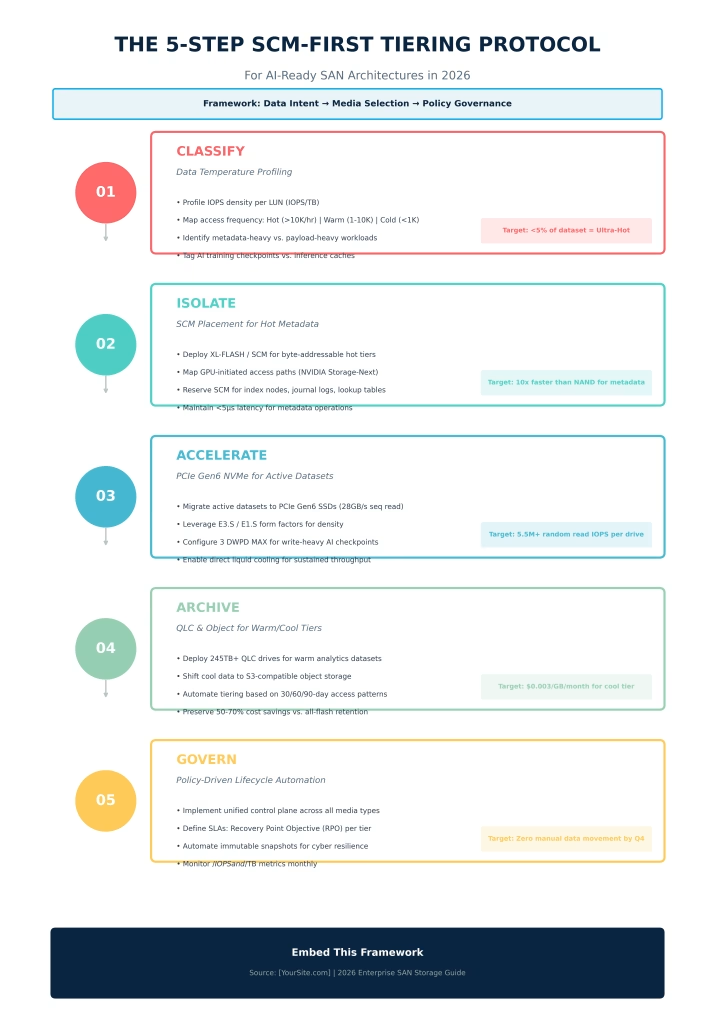
The 5-Step SCM-First Tiering Protocol
“The 5-Step SCM-First Tiering Protocol for AI-Ready SAN Architectures” — A process framework designed to help SAN architects classify, place, and govern data across SCM, Gen6 SSD, QLC, and object tiers.
Data Points / Text Layout:
- Step 01 — CLASSIFY: Profile IOPS density per LUN; map access frequency (Hot >10K/hr, Warm 1–10K, Cold <1K); identify metadata-heavy vs. payload-heavy workloads; tag AI training checkpoints vs. inference caches. Target: <5% of dataset = Ultra-Hot.
- Step 02 — ISOLATE: Deploy XL-FLASH / SCM for byte-addressable hot tiers; map GPU-initiated access paths (NVIDIA Storage-Next); reserve SCM for index nodes, journal logs, lookup tables; maintain <5μs latency for metadata operations. Target: 10× faster than NAND for metadata.
- Step 03 — ACCELERATE: Migrate active datasets to PCIe Gen6 SSDs (28 GB/s seq read); leverage E3.S / E1.S form factors; configure 3 DWPD MAX for write-heavy AI checkpoints; enable direct liquid cooling for sustained throughput. Target: 5.5M+ random read IOPS per drive.
- Step 04 — ARCHIVE: Deploy 245TB+ QLC drives for warm analytics; shift cool data to S3-compatible object storage; automate tiering based on 30/60/90-day access patterns; preserve 50–70% cost savings vs. all-flash retention. Target: $0.003/GB/month for cool tier.
- Step 05 — GOVERN: Implement unified control plane across all media types; define SLAs and RPO per tier; automate immutable snapshots for cyber resilience; monitor $/IOPS and $/TB metrics monthly. Target: Zero manual data movement by Q4.
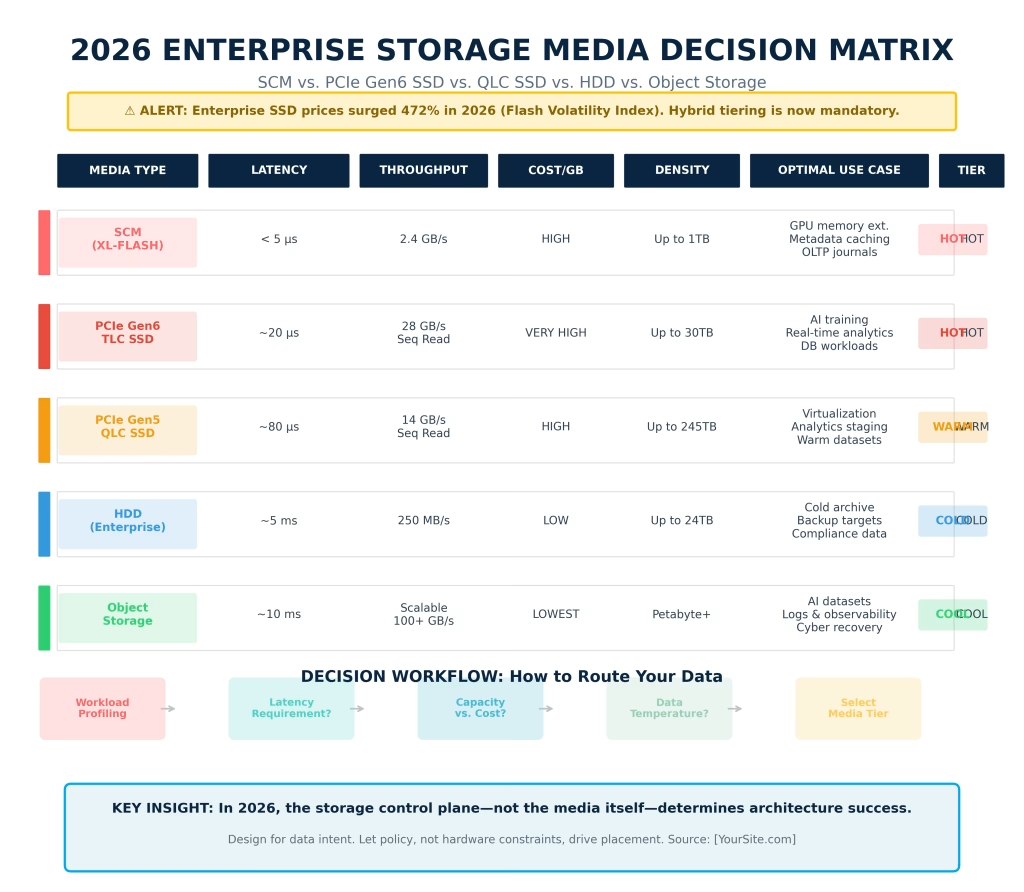
2026 Enterprise Storage Media Decision Matrix: SCM vs. PCIe Gen6 SSD vs. QLC SSD vs. HDD vs. Object Storage
- SCM (XL-FLASH): Latency <5 μs, Throughput 2.4 GB/s, Cost/GB Highest, Density up to 1TB, Use Case: GPU memory extension, metadata caching, OLTP journals. Tier: HOT.
- PCIe Gen6 TLC SSD: Latency ~20 μs, Throughput 28 GB/s seq read, Cost/GB Very High, Density up to 30TB, Use Case: AI training, real-time analytics, database workloads. Tier: HOT.
- PCIe Gen5 QLC SSD: Latency ~80 μs, Throughput 14 GB/s seq read, Cost/GB High, Density up to 245TB, Use Case: Virtualization, analytics staging, warm datasets. Tier: WARM.
- HDD (Enterprise): Latency ~5 ms, Throughput 250 MB/s, Cost/GB Low, Density up to 24TB, Use Case: Cold archive, backup targets, compliance data. Tier: COLD.
- Object Storage: Latency ~10 ms, Throughput scalable 100+ GB/s, Cost/GB Lowest, Density petabyte+, Use Case: AI datasets, logs & observability, cyber recovery. Tier: COOL.
The 2026 SAN Storage Glossary
This section is designed for citation. Other writers can quote these definitions verbatim and link back to this guide as the authoritative source.
| Term | Definition |
|---|---|
| SCM-First Tiering | A data placement framework that prioritizes Storage-Class Memory for ultra-hot metadata and small random I/O, using NAND flash for payload data and object/HDD for cool tiers. |
| GPU-Initiated Storage | An architecture where GPUs directly address flash memory as an expansion of HBM, bypassing traditional CPU-mediated storage stacks. Defined by the NVIDIA Storage-Next initiative. |
| Flash Volatility Index | A market benchmark tracking enterprise NAND pricing; in 2026, it recorded a 472% price increase for 30TB TLC drives between Q2 2025 and Q1 2026. |
| Data-Intent Architecture | A design philosophy where data placement is governed by access patterns, lifecycle policies, and SLA requirements rather than hardware constraints or media homogenization. |
| QLC Endurance Matching | The practice of aligning workload write density (DWPD requirements) with QLC media endurance to enable safe deployment of high-density, low-endurance flash in warm tiers. |
| Fabric-First Sizing | A SAN design methodology that sizes network fabric bandwidth before selecting drive media, ensuring that front-end throughput does not bottleneck back-end drive performance. |
Common Mistakes & Counter-Intuitive Advice
Mistake 1: “We Should Delay Refresh Until Prices Normalize”
The Counter-Intuitive Truth: Prices will not normalize in 2026. Kioxia’s entire 2026 production is sold out. Hyperscalers have multi-year supply agreements. Waiting for pre-2025 pricing is a strategy for obsolescence, not savings.
The Correct Play: Refresh selectively. Move cold data off flash immediately. Invest in SCM and Gen6 only for workloads where latency directly correlates to revenue (OLTP, AI inference, real-time fraud detection). Let object storage and HDD absorb everything else.
Mistake 2: “All-Flash Arrays Are Always Better Than Hybrid”
The Counter-Intuitive Truth: In 2026, an all-flash array carrying cold data is a financial liability, not a performance advantage. With SSDs at 22× the cost of HDDs, storing 90-day-old logs on flash is indefensible.
The Correct Play: Judge arrays by their control plane intelligence, not their media uniformity. A hybrid array with automated policy-driven tiering will outperform a dumb all-flash array on both cost and effective IOPS per dollar.
Conclusion: The 2026 SAN Architect’s Checklist
2026 is not the year of a single breakthrough technology. It is the year of coexistence—where SCM, Gen6 TLC, QLC, HDD, and object storage each serve distinct roles under a unified governance layer.
Downloadable Action Checklist
- [ ] Profile every LUN for IOPS density and access frequency. Tag AI workloads separately.
- [ ] Size your fabric first. Ensure 200GbE or NVMe-oF can absorb Gen6 throughput before buying drives.
- [ ] Reserve SCM for metadata and GPU-initiated access paths. Do not waste it on bulk payload.
- [ ] Match QLC endurance to workload write density using the DWPD formula before deployment.
- [ ] Automate tiering policies with 30/60/90-day triggers. Eliminate manual data movement.
- [ ] Implement immutable snapshots for cyber resilience on every performance tier.
- [ ] Monitor $/IOPS and $/TB monthly, not just capacity utilization.
- [ ] Design for data intent, not media type. Your architecture must absorb 2027’s media without redesign.
FAQ
Q1: What is the biggest SSD technology change in 2026?
PCIe Gen6 enterprise SSDs are now shipping, with Micron and Samsung both delivering drives capable of ~28 GB/s sequential reads and 5.5–6.8 million random read IOPS—roughly double the throughput of Gen5.
Q2: Why did enterprise SSD prices increase so dramatically in 2026?
The generative AI boom consumed the global NAND flash supply. According to the Flash Volatility Index, 30TB TLC enterprise SSD prices surged 472% between Q2 2025 and Q1 2026 as hyperscalers secured multi-year production allocations.
Q3: What is SCM, and why does it matter for SAN architects in 2026?
Storage-Class Memory (SCM) provides byte-addressable, persistent storage with latency under 5 μs—10× faster than NAND. In 2026, it became essential for GPU-initiated AI workloads (NVIDIA Storage-Next) and for accelerating metadata on high-density QLC arrays.
Q4: Should I still buy all-flash arrays in 2026, or move to hybrid?
Hybrid tiering is now mandatory for cost efficiency. With enterprise SSDs at 22× the cost of HDDs, storing cold data on flash is economically unsustainable. The best architectures use SCM for hot metadata, Gen6 SSD for active data, QLC for warm data, and object/HDD for cool/cold data—governed by a unified control plane.
